
If you’re nymphing the Missouri River and you don’t have scud patterns in your box, you’re missing one of the most consistent producers on the water. These little freshwater shrimp don’t get the attention that PMDs or Caddis do, but they’re in the river every single day of the year, and the trout know it.
The Missouri below Holter Dam has scuds. A lot of them. The cold, consistent water coming out of the dam and the weed beds that run from Craig all the way down to Cascade make this river about as good as it gets for freshwater shrimp. Trout eat them every month of the year, not just when nothing else is happening, but alongside the hatches, underneath the dry fly takes, and on the days when you can’t figure out what’s going on. I’ve never had a day on the Mo where scuds didn’t belong in the box.
Here’s what we fish.
Why the Missouri River Produces So Many Scuds
Scuds, freshwater shrimp in the family Gammaridae, thrive in cold, clean, well-oxygenated water with abundant aquatic vegetation. The Missouri below Holter Dam checks every box. The dam regulates water temperature year-round, keeping the river cold even in late summer. The weed beds that blanket the river bottom from Craig to Cascade provide ideal scud habitat, dense cover, plenty of algae to feed on, and constant current to deliver oxygen.
Unlike insects that hatch and disappear, scuds don’t have a season. They are available to trout 365 days a year, which is exactly why Missouri River trout eat them so consistently. A rainbow that’s seen a hundreds of PMD imitations in a season will still eat a well-presented scud without hesitation. They’re that reliable a food source.
One thing worth knowing: when scuds die, they turn orange. Trout know this, and they key on that color hard. It’s not a coincidence that pink and orange scud patterns consistently outperform natural colors, a dead or dying scud drifting in the current is an easy, high-visibility meal. Keep that in mind when you’re picking colors.
The Best Missouri River Scud Patterns
Flashback Scud
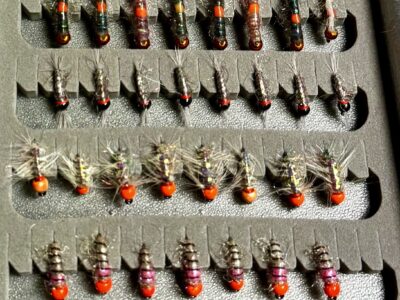
The Flashback Scud is the workhorse. The flash rib adds just enough UV and light-catching movement to trigger strikes without going full attractor. Rainbow and gray are my go-to colors — they match what’s actually living in the Missouri’s weed beds. Fish it in sizes 12–18 on a dead-drift tight to the bottom. This is the pattern I start a lot of spring and falls days with when I don’t know exactly what the fish are keyed on. It works in every season and every water condition.
Pink/Orange Scud
When the tributaries in the spring are high and putting some color into the main river or you’re fishing in lower light conditions, a pink or orange scud can outperform natural colors by a wide margin. And as mentioned above , dying scuds turn orange, and trout are wired to eat them. The pink scud works especially well as a dropper behind a heavier point fly. Don’t overthink the reasoning.
Caviar Scud
The Caviar Scud is an attractor-style pattern tied to imitate scuds, and it’s become a staple on tailwaters like the Missouri. The firebead version is the one I carry. It’s a go-to from winter through early spring when trout are holding deep and feeding on protein-rich food sources close to the bottom. The hot bead gives fish a target when they’re sluggish and won’t chase. Fish it slow, fish it deep, and let it do the work.
Pink Amex
The Pink Amex is a Czech nymph-style pattern, heavier, more compact, built to get down fast in deeper runs. When trout are stacked in the nymph runs and you need to get it down quickly, this is the fly. It works as a point fly in a two-fly rig with a smaller natural scud trailing behind. Olive and natural versions exist, but pink is the one that produces consistently on the Missouri.
How to Fish Missouri River Scud Patterns
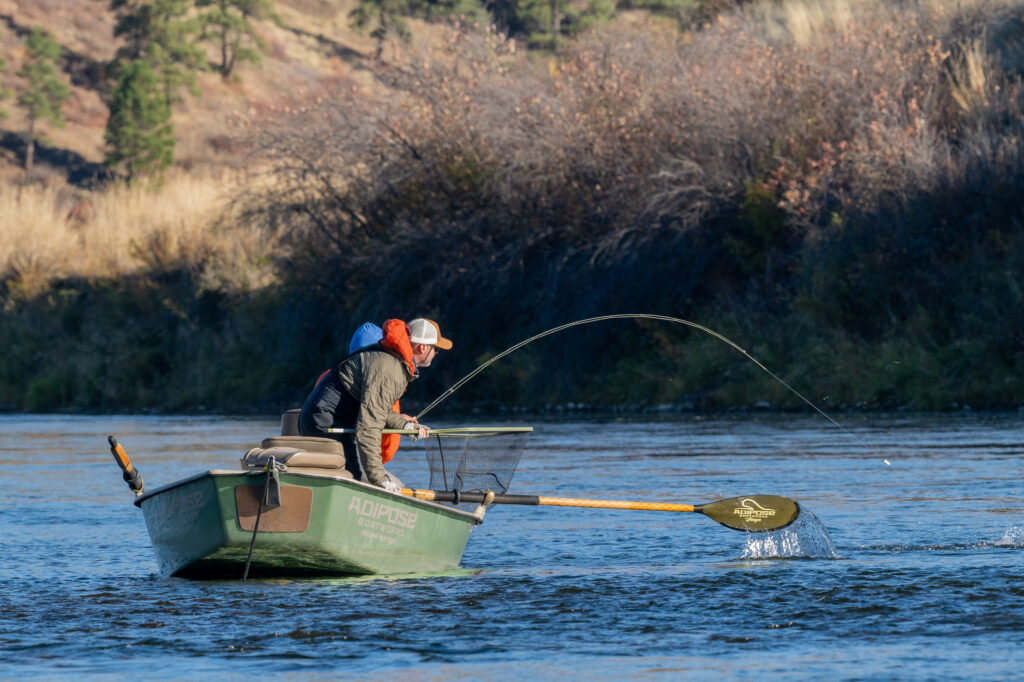
Indicator depth: A standard nymph rig on the Missouri is about 3 to 6 feet from the split shot to the bobber. If you’re not occasionally ticking structure, make an adjustment to depth or weight.
Split shot: Run split shot 16 -20 inches above your point fly. You want to tick the bottom occasionally, that’s how you know you’re in the zone.
Two-fly rig: A standard setup is a heavier scud (Caviar or Pink Amex) as the point fly with a smaller Flashback or natural-color scud trailing 16–18 inches off the bend. The heavier fly gets the rig down, the trailing fly does the convincing. Spring we may switch out the top fly for a worm to and unweighted scud.
Tippet: 3X for standard conditions. Drop to 4X in low, clear water when fish are being selective. The Missouri runs clear, don’t go heavier than 3X or you’ll notice the difference.
Go big: Most blogs on the interwebs will tell you to fish scuds small. On the Missouri I’ll fish them as large as size 12–14, especially in fall when we see a lot of scuds in the system and fish are looking for a substantial meal. Don’t be afraid to tie on something bigger.
Missouri River Scud Patterns by Season
Scuds are available to trout year-round, but how and when you lean on them changes with the seasons.
Winter (December–February) is when Missouri River scud patterns are at their absolute peak value. Hatch activity slows dramatically, midge fishing gets technical, and trout are holding deep in slow runs conserving energy. A Caviar Scud or Pink Amex fished slow and deep will out-fish most other patterns in the box during this window. Sizes 14–18 and fish the painfully slow winter water. The fly needs to come right to the fish. They’re not chasing anything in January.
Spring (March–May) is prime time. Water temps start to climb, trout become more active. Pre-runoff conditions on the Missouri can be some of the best nymphing of the year. Run a heavier worm to a Caviar or Pink Amex. This is also when the orange and pink colors really shine, fish are aggressive and looking for an easy meal.
Summer (June–August) is hatch season, but scuds never fully leave the picture. Before the PMD gets going in the morning, or during the midday lull when surface activity stalls, a scud dropper behind a dry fly will keep the rod bent. This is also the time of year to size down, fish 16–18 in clear, low summer flows and stay light on the tippet.
Fall (September–November) is a fantastic time on the Missouri to fish scuds. The weed beds are starting to break up, the scud population is at its highest point of the year, and fish are feeding hard before winter sets in. This is when I’ll go big size 12–14 because the fish are actively looking for a substantial meal and there’s no shortage of large scuds in the river. This is also when sow bugs are thick. Running a scud and a sow bug pattern in the same two-fly rig is a legitimate fall strategy on the Mo.
Ready to Put These Patterns to Work?

 Hopper Fishing the Missouri River
Leave a Reply